Saturday, March 30, 2013

Easter and Meals


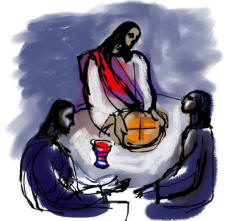
            The Rev. Dan Warren has often commented that the sound of dishes rattles through the New Testament. Jesus was forever sharing meals with people. Undoubtedly his most famous meal is the Last Supper, when he took bread and wine and sanctified them as his own body and blood.
            Recall for a moment that Last Supper.  Think of the intimacy of Jesus washing the disciples’ feet, and then his gift of the Eucharist -- and then also remember that this was the last meal of a condemned man.  He tells the disciples up front, “I have earnestly desired to eat this passover with you before I suffer.” -- I want to eat with you, my friends, before I die.
            Hearing this, I think of the families I used to visit when I was a pediatric hospice chaplain.  How often the children would ask parents to take them out to a favorite restaurant!  Gathering with the family around a table away from the medical paraphernalia of a terminal illness was their deepest desire.  Like Jesus, they knew they would die, condemned by their disease or their condition.  Yet, also like Jesus, they understood shared meals as a celebration of life, as a kind of sacred bonding.
            I love the post-resurrection story of Jesus cooking breakfast on the shores of the Sea of Galilee.  When I think of these children, I like to imagine not a grand banquet, but Jesus waiting for them on the other shore, cooking their favorite breakfast.
            My prayer for all of us this season is that we find time to share a special family meal, to celebrate well, to rattle our own dishes and give great good thanks for this life, and the life to come.
            

Saturday, March 23, 2013

Easter Family Liturgy


Holy Week offers an astonishing array of human experience: celebration and shared meals, betrayal and loneliness, suffering and death, grief and guilt, sacred mystery, awe and wonder and joy beyond our capacity to explain. It’s the heart of our salvation history, the Christian journey through death to new life. I hope you and your children are able to take part in some of the services that follow Jesus through his Passion.

What I’ve chosen to offer here out of all this array are suggestions for sharing a simple celebratory “Festal Meal” for Easter, incorporating some of my earlier suggestions for the season.

First, prepare the table. An Easter table should have a profusion of flowers as a centerpiece. If you are lucky enough to have flowers already growing in your yard, invite the children to help pick some. Here in Maine, a recent snowstorm means we’ll be having a “white Easter” so no flowers of our own, but even the local grocery store offers rows and rows of colorful flowers, so you can take the children on a special trip to choose their favorites.


As a way of marking where everyone will sit at the table, use the decorated containers of wheat grass (from February16, 2013 post), topped with a colored egg (February 23). 
           
Put bells at each person’s place, and have a candle for an adult to light at the start of the meal.

If you have time to make hot cross buns (March 8), there’s a special time at the start of the meal to eat them, but any bread, rolls, biscuits, or other grain-based option would also be a fine accompaniment to singing “Now the Green Blade Rises” as part of the short family liturgy (see below).

Once you’ve prepared the table, it’s time to prepare the children by teaching them the appropriate responses and gestures that go with the prayers (see the meal itself);

·       Teach them when they respond, ”God was with them,” to stretch out their arms, palms up


·       Teach them when they respond, “God is with us,” to hug themselves by crossing their arms and putting their hands on opposite shoulders.


·       After each blessing, teach them to respond: “Amen.”

And if you haven’t yet taught them “Now the Green Blade Riseth” (February 16), consider doing so now, even if there’s only time to learn one verse. The children could then teach any grown-ups who haven’t yet learned it. If your children are old enough to read, you could even print out copies of the lyrics for everyone.

Feel free to simplify the liturgy as feels right for your family, even down to using just the blessings at the end. Any small good thing we do at home to nurture our children’s faith blesses them, and us.


Festal Meal Liturgy for Easter


An adult should light the candle and say: The Light of Christ.

Everyone:  Thanks be to God.

Adult:  Even when Jesus died on the cross and his disciples ran away because they were scared,

Children (with arms outstretched, palms up, demonstrated by an adult):  God was with them.

Adult:  Even when we are sad or scared,

Children (with arms crossed, hands on opposite shoulders as though hugging themselves, demonstrated by an adult): God is with us.

Adult:  When the women found the empty tomb on Easter morning and knew Jesus was alive,

Children (arms outstretched):  God was with them.

Adult: Whenever we are surprised by joy,

Children (arms crossed):  God is with us.

At this time, the adults should lead the children in ringing their bells to acknowledge and celebrate  Jesus’ Resurrection by making a joyful noise. Then all should join in singing “Now the Green Blade Riseth,” accompanied, if available, by tambourines and/or drum, or just the bellss. Afterwards would be an appropriate time to share the hot cross buns, reminding the children how the plain bread of sorrow became the sweet bread of Easter, or how grain is what’s used to make bread.  After a suitable amount of time for eating buns, an adult should ring a bell to recall the children to the liturgy.

Adult: As we share this Easter meal together,

Children (arms crossed):  God is with us.           

Adult:   And now may God the Creator bless us.

Children:  Amen.

Adult:  May God the Risen Son be our companion.

Children:  Amen.

Adult:  May God the Holy Spirit dwell within us.

Children:  Amen.

Everyone:  Thanks be to God!
                                    

Friday, March 15, 2013

Life, Death, and Easter


image from www.papertigers.org

Telling the Christmas story is easy: the birth of a baby in a stable surrounded by animals is a story filled with light and joy.

Death is harder. Even death followed by Resurrection. Crucifixion was a torturous death to begin with, and we live in a culture that doesn’t do well in talking about any kind of death. But our Lord's death and Resurrection are foundations of our faith, so along with growing wheat grass and decorating eggs and making hot cross buns, you might consider another way of sharing the Easter story with your children. Below are a few suggestions of books for children that either tell the Easter story, or that deal with the difficult subject of death. 


Books about Easter:

The Easter Story, Brian Wildsmith

“Brian Wildsmith's own passion for the story of Jesus's crucifixion and resurrection is unmistakable in his glorious, metallic-gold-hued illustrations, which tell the story more vividly than words ever could. In fact, to his credit, Wildsmith adapts the story of Jesus's last days in as simple and straightforward a manner as possible, allowing young readers to glean the substance from the paintings, symbolism, and, most likely, discussion with grownups who may be reading along. The donkey's-eye-view of the events allows a slightly different perspective from the standard, without being overly intrusive as a literary device. Lush jewel tones capture the richness of the narrative, and mesh in a strangely beautiful way with the simple paintings of Jesus, the angels, Mary Magdalene, and others in the biblical cast of characters. The Easter Story will make a gorgeous addition to any Easter basket. (Ages 5 and older)”
Amazon.com Review

The Legend of the Three Trees – Picture Book, Anne McCafferty

"Vivid visual imagery brings this classic legend to life. Told simply, in language even the youngest family members will understand, the story beings with three young trees who dream - as children do - of doing big deeds.
When the woodcutters come, the trees each find that the reality of their existence doesn't match their dreams… and yet… This touching story contains a simple lesson about God's Plan for every life, told in a way that will touch hearts."  (Age Range: 3 - 7 years) Book Description on Amazon.com

Books about the death of pets:

The Tenth Good Thing about Barney Judith Viorst

"Because the life cycle of animals is so short, it's usually the first death a child experiences. Fortunately, there are good children's books to help in many difficult situations. This book works better than any other book on the subject. It is the story of a small boy who is trying to understand and recover from his cat's death. The author is honest and authentic in her approach." Barnes & Noble Editorial Review, Children's Literature - Susie Wilde

Sammy in the Sky Barbara Walsh and Jamie Wyeth


“The title of Walsh's debut and the use of the past tense make it clear that Sammy, "the best hound dog in the whole world," is not going to make it: "Daddy found a bump on Sammy's neck; it was as big as a baseball." Wyeth's (Cabbages and Kings) watercolors capture Sammy's floppy ears, patient expression, and sloppy kisses for his overall-wearing mistress; readers will love him, too, and they'll find his impending death just as difficult as his owners do. The girl's mother tells her what to expect: "When he leaves, his body will be like an empty shell, but his spirit will be everywhere.... All the good things about Sammy, like his love for you, will be yours to keep forever." The family travels through their grief together: "You're still the best hound dog in the whole wide world," the girl shouts to a Sammy-shaped cloud as they gather months later on the beach to celebrate his life. As a model of good mourning, it's a fruitful resource; as an account of loss, it goes to the pit of the stomach." (Ages 4–7) Publishers Weekly review

Books about loss / death:

Waterbugs and Dragonflies Doris Stickney

"How can we answer the many questions young children have about death? Looking for a meaningful way to explain the death of a five-year-old friend to neighborhood children, Stickney adapted a graceful fable about a water bug that changed into a dragonfly. First published as a book in 1982, it has become The Pilgrim Press's bestselling book, Water Bugs and Dragonflies." Book Description on Amazon.com

The Invisible String Patrice Karst


"Specifically written to address children's fear of being apart from the ones they love, The Invisible String delivers a particularly compelling message in today's uncertain times that though we may be separated from the ones we care for, whether through anger, or distance or even death, love is the unending connection that binds us all, and, by extension, ultimately binds every person on the planet to everyone else. Parents and children everywhere who are looking for reassurance and reaffirmation of the transcendent power of love, to bind, connect and comfort us through those inevitable times when life challenges us." (Ages 3 and up).  Book Description on Amazon.com

Friday, March 8, 2013

Light, Water, and Hot Cross Buns: more Easter preparation for families


Some random background notes on Easter
            Easter is the joyful celebration of Christ’s breaking the bonds of death and appearing to his friends and followers in bodily form. Easter Day is celebrated on the first Sunday following the first full moon on or after the spring equinox; the Easter season extends through the next seven weeks.
             The word “Easter” refers to the east, to the rising sun.  Pagan converts who had worshipped a sun god saw in the nightly death and daily rebirth of the sun a representation of Jesus’ death and resurrection; consequently, not only the name but many of our Easter customs incorporate these older practices.
             The gospel accounts of the resurrection indicate that the experience was confusing and frightening at first for Jesus’ friends.  Because Jesus returns to his followers in bodily form, he is familiar and dear to them, but because he is risen from the dead, he is also profoundly “other”. Easter celebrates an event beyond our understanding, a demonstration of God’s love for humanity that defies all expectation.

The Light of Christ
            An old European belief said that the sun itself literally dances for joy on Easter morning; anyone who sees the sun dancing at dawn that day will have good luck all year.  This belief led to the practice of going to high places early on Easter to witness dawn. In the United States, dawn comes first to Cadillac Mountain in Maine, and every Easter people gather there to watch the sun rise out of the North Atlantic. 
            Back when women didn’t have the leisure to join the watchers but were expected to be home preparing the morning meal, they would put a pan of water or a mirror on the windowsill to catch the first dancing rays of the sun.
            In pre-Christian Europe, pagans used to burn bonfires in the spring to honor the sun god.  Such practices were outlawed during the early years of conversion, but St. Patrick Christianized the idea by blessing a new fire at Easter. In Patrick’s time, people would bring sticks to light in the new fire, and then take the burning sticks home to light their own lamps and fires.  In our own time, people light candles from a newly stuck fire at the Easter Vigil and then use the candles to light the dark church during the first part of the service.

Holy Water
            As Holy Saturday moves toward Easter, this is referred to as the Passover of Jesus since this is when he passed from death to life.  The ancient name for Easter was Pasch, derived from the Hebrew word for Passover. The blessing of water for baptism during the Easter Vigil includes overt reference to the first Passover: the survival of the Israelites as death passed over their homes, and their subsequent escape through the parted waters of the Red Sea.
            Throughout ancient Europe, pagans revered the waters of spring that seemed to melt the ice on streams and ponds. People would splash each other with spring waters for health and good luck.  (Some European farmers still sprinkle their animals with water drawn during the Easter season.)  Christian priests adapted this custom by blessing local streams and ponds on Easter Day.  Just as people took home fire from the newly blessed Easter fire, so they took home water gathered on Easter and saved it all year to use for its healing quality.           

Making Hot Cross Buns
             Originally these were very plain buns with a cross made out of dough across the top; they were eaten on Good Friday.  Now the buns are sometimes filled with fruits and nuts, then topped with a cross made of frosting.  They are often eaten throughout Lent, as well as on Easter.
As you make these buns with the children, tell them how the bread of sorrow became the sweet bread of celebration.  While you’re working, if you know the old street vendor’s “Hot Cross Buns” call, teach it to them. You can find a version at: http://www.youtube.com/watch?v=Ndd-6WB5vlo
            To make hot cross buns, use your favorite basic sweet bread recipe, or go online to find one. You can also use frozen bread dough, defrosted. Whatever dough you use, while you are kneading, you can add either candied fruit or dried apricots and raisins, steamed soft and (for the apricots) cut into small pieces; you can include chopped walnuts, too, if the children like nuts, and flavor the dough with a teaspoon of allspice or cinnamon.  Dough made with four cups of flour will make about 20 buns. After the dough has gone through one rising, punch it down and have the children shape it into smooth balls,.  Set them two inches apart on a greased baking sheet and flatten slightly with the palm of your hand or the bottom of a glass or mug. Preheat the oven to 375 degrees. Let the buns rise until double in bulk, brush with a wash made of an egg yolk beaten with a tablespoon of milk or cream, then bake for about 12 minutes. Remove to wire cooling racks and -- after they are cool -- draw a cross on each bun using a simple confectioners sugar frosting (a cup of powdered sugar, a tablespoon of cold milk, and a teaspoon of vanilla).  Note: if you try to put the frosting crosses on while the buns are still hot, the frosting will melt and slide off.  Let them cool.


Saturday, February 23, 2013

Eggs, whales, and butterflies: more Easter preparation


                                                    photo from www.plainvanillamom.com

Let's start with the most basic of all Easter activities: dying hard boiled eggs.  Although the intricate designs of Ukrainian eggs are famous, another tradition of the Ukraine is to dye eggs in a single bright color.  For a step by step explanation of how to do this, check out <http://www.plainvanillamom.com/2012/04/coloring-easter-eggs-with-food-coloring.html>. Before your Easter dinner, have the children place the eggs in the containers of newly grown grass (from last week's suggested activity).

Historic note:   During the Middle Ages when infant mortality was high, bereaved mothers in the Ukraine took comfort during Easter by sending something tangible to the souls of their children. They told the story of the Blazhenni, spirits who live on the edge of the world where all the streams and rivers come together; these Blazhenni, they believed, were the souls of unbaptized babies.  On Easter, grieving mothers would throw the shells of red-dyed eggs into nearby rivers and streams, believing that when the shells reached the Blazhennni, they would know that it was Easter and they, too, could celebrate.  The Blazhenni were gentle spirits who ate no meat, except on the day the red shells reached them. 
           
Another activity in preparation for Easter is to decorate an Easter Tree with ornaments of eggs, whales, and butterflies.  Choose a tree or shrub in the yard, or bring a branch indoors to use as your Easter Tree. In preparation for making whale decorations, tell the children the story of Jonah and the whale (read it from Scripture, paraphrase it on your own, or use one of the many picture books -- Amazon lists 1, 618 versions of this story!). Jesus told his followers: “For as Jonah was three days and three nights in the belly of the whale, so will the Son of man be three days and three nights in the heart of the earth.” No wonder the early church celebrated the story of Jonah and the whale as symbolic of Jesus’ death, entombment, and resurrection!
           
Then as the children work on butterfly decorations, tell them about the metamorphosis of caterpillars into moths and butterflies through the seeming tomb of the cocoon, and tell them that the butterfly--also symbolic for the early church--is still used today to represent Jesus’ resurrection.  Both Golden Books and Scholastic Books offer readable explanations and clear illustrations of the metamorphosis, or you could read Eric Carle’s lively classic, The Very Hungry Caterpillar. 
            
If you haven’t talked about eggs while coloring them, do so as they make egg ornaments. Since ancient times, eggs have been symbols of fertility and new life.  Many cultures believed that the world began as an egg; the Hindus, for example, said that the “World-Egg” was formed in “the waters of chaos” before the beginning of time.  Christians adopted the egg as an Easter symbol because, like the dry, hard seed that brings forth new plant life, seemingly hard eggs bring forth new animal life.  In both cases, what seems dry and hard and dead actually contains new life.  This hiddenness is part of the strangeness and surprise of Easter itself. 
           
For activities that echo this theme of hiddenness, have an old fashioned Easter egg hunt, either with hard-boiled eggs or with foil-covered  chocolate eggs.  Be sure to have extras to pass out at the end so that the less successful hunters don’t have empty baskets or bags.  (If the successful egg-hunters complain, tell them the parable of the laborers in the vineyard from Matthew 20; or use Dina Strong’s retelling of this parable in her book The Vineyard and the Wedding.)  Another option would be to get a piñata that holds hidden treasures; if you can’t find piñatas locally, you can online -- eggs, whales, and butterflies! Hang the piñata from a high place, and take turns blindfolding the children and having them swing a broomstick or other long stick at it (remember to have everyone else stand far back while this is going on). When a child finally manages to break open the piñata, all the children get to gather and share the goodies. 

Saturday, February 16, 2013

Watching the grass grow: helping children get ready for Easter


Looking at Lent as a purely penitential season isn’t helpful for children, who often have an exaggerated sense of guilt to begin with. My very first memory involves getting in trouble for picking our neighbors tulips when I was three years old. And when I was a little older, I spent years praying to be forgiven for pocketing a penny I found at a cousin’s house.

While it’s important to acknowledge that we don’t always get things right or behave as we should, it’s also essential to let children know that God loves and forgives, always. Nothing we can do can separate us from God’s love. We always have a chance at new beginnings.

That’s why I’m going to use Lent as a time to suggest ways to get ready for the celebration of Easter rather than provide specific activities for Lent itself.

I’m starting with this first activity because it takes time to prepare – and then there’s the waiting.  We’re going to grow grass.

A week or ten days before Easter, have the children plant wheat grass seeds in small containers such as paper cups or small bowls.  You can check with health food stores for whole wheat seeds (sometimes called wheat berries), or you can get wheat grass seeds to grow for indoor cats from your local pet store.  Here are a couple of online options:

·      * hard red wheatberries: http://www.bobsredmill.com/hard-red-wheat-berries.html


You will also need potting soil to put in the small containers. These containers of grass can then be used as nests for colored eggs and put at everyone’s place at the table for Easter dinner. There's something alive and lovely about growing grass indoors.

For an art activity before you fill the containers and plant the seeds, have the children decorate their containers with pictures of grass or flowers or the sun or bright abstract designs--whatever pleases them.  They can make the designs on paper and tape or glue them to the containers, or they can work directly on the containers themselves if the surface allows. 

Once you have seeds, potting soil, and decorated containers, here’s what to do:

·      * soak the seeds in water overnight 
·      * plant them in small containers of potting soil
·      * water enough during the week to keep the soil damp

Before or after the children plant the seeds, you can teach them the Easter song  “Now the Green Blade Rises.”  Below are three different presentations of the song.

·      * with guitar accompaniment: http://www.youtube.com/watch?v=LIPc8Ycl638
·      * by a college quartet: http://www.youtube.com/watch?v=xP9HG8qIgnc
·      * Ely Cathedral choir: http://www.youtube.com/watch?v=27p98aLPZPI

Slightly varied versions of the lyrics can be found:


Where I live in Maine, some years the grass outside is buried under snow until long after Easter.  One year when the snow was especially deep, I planted wheat grass seeds in a ceramic bowl and took it to school where it spent a month on my desk. Adolescent students in my English classes would walk by and touch the growing grass, pat it, run their hands over it. That small container of earth and green evoked such longing for spring in all of us that it seemed a sacred thing in a very secular place.

Now the green blade riseth from the buried grain,
Wheat that in dark earth many days has lain;
Love lives again, that with the dead has been:
Love is come again, like wheat that springeth green.

Sunday, February 10, 2013

“Chemistry is not destiny” (thoughts in preparation for Lent)


When I was growing up, we were supposed to spend the 40 days of Lent contemplating all the ways we sinned, all the ways we failed to measure up – not easy for a kid, and probably not healthy either, unless it was balanced by the constant reminder that even if we snuck that extra cookie or harbored thoughts of putting piranhas in our neighbor’s bathtub, God loved us and was willing to forgive us.

The Baptismal Covenant in the Episcopal prayer book asks, “whenever you fall into sin, [will you] repent and return to the Lord?” The assumption is that of course we will sin. As Christians, however, we are to understand that our capacity for egregious behavior does not determine our destiny. Salvation is not only possible, but promised.

And what does all this have to do with parenting? Or chemistry? 

I want to start with another quotation from Paul Tough’s How Children Succeed: “scientists have demonstrated that the most reliable way to produce an adult who is brave and curious and kind and prudent is to ensure that when he [or she] is an infant, his hypothalamic-pituitary-adrenal axis functions well.” That’s the chemistry part, and it happens when parents provide nurturing attention to their infant. (I wrote more about this back in the post on “Rat moms.”) 

But if babies don’t receive this early tending, teachers, clergy, social workers, and neighbors -- as well as the parents themselves – can later intervene in ways that help build character, all the way through adolescence. “Chemistry is not destiny,” Tough writes. That means that the times we unintentionally caused pain or neglected our kids don't have to result in irreparable damage to their character. Our children can still become brave and curious and kind….even if we haven’t always been so ourselves. We can try to do better, and we can not only allow but encourage others to help. 

This strikes me as one of the lessons of Lent: just as the body chemistry established in infancy doesn’t have to determine our destiny, neither do our piranha-like tendencies have to determine our relationship with God.  In both cases, redemption is possible. -- On the other side of Lent, after all, is the resurrection promise of Easter.


Note: once we move into Lent itself, I will begin posting ideas for crafts and activities families can do in preparation for Easter. Despite having its own liturgical color, Lent is not a stand-alone season but always looks to the promise of Easter.


Friday, February 1, 2013

The sins of the fathers…and quantum physics


One of my daughters-in-law recently shared a CNN article about the increasingly devastating effects of Agent Orange on children in Vietnam and the grandchildren and great-grandchildren of American veterans of that war.  The deformities get worse; what we did then affects those being born now.

Reading the article brought to mind the words from Scripture about how the “sins of the fathers” will be visited upon the children for generations to come. I used to think this was meant to describe the actions of a stern and terrifying God, but I realize now that it simply describes what actually happens: our children inherit the unintended consequences of our behaviors. Generationally, they live with climate change and national debt and, if their grandfathers were exposed to Agent Orange, with the potential for inheriting debilitating deformities.

Once again, here is a place where Scripture and science agree: everything is interconnected. As the physicists say, “Action in one place, even at a distance, affects action in another place” because “at a level we can’t discern, there is an unbroken wholeness.”*  As St. Paul says, “If one member of the body suffers, we all suffer together.”

This interconnectedness, by the way, isn’t just about the bad things; it embraces the good as well.  The smile, the vote, time spent reading to a child, faithfully going to a difficult job, raising money or awareness for a good cause – all these, too, have far-reaching effects.  Everything -- the physicists say, Jesus says -- everything is interconnected.  “Whatever you do to the least of these, you do to me,” across time, across space, across generations.

So what should we do today to tend our children – and the universe? We can’t do one without affecting the other because they are, after all, part of an unbroken wholeness, all of it held together in God. 


*(from Margaret Wheatley)

Sunday, January 27, 2013

Let the Little Children Suffer? Sometimes….


I want to look again this week at Paul Tough’s book How Children Succeed, this time about how responsive, calm, affectionate attention helps children become “more self-confident, more curious, and better able to deal with setbacks” – especially that “dealing with setbacks” part.  I hate that part. I look at my two infant grandchildren and don’t ever want them to suffer.

The importance of holding and loving our babies is pretty easy compared to watching them – letting them – face failures and setbacks and suffering as they grow. I wanted to wrap my own children in protective gauze when they were little. When my first was about two months old, I had him in a front-carrier with a cape wrapped around us both to shield him from Colorado’s winter wind. A friend stopped me on the street and said, “I thought you’d already had your baby!”  I unwrapped the cape and commented, “I’m now wearing him on the outside.” I remember another friend whose baby weaned herself at 15 months; “I would have nursed her till she went away to college,” was the mom’s wistful response. We both clearly had that “hold and love” part down pat.

Reminder:  We are all beloved children of God.  As one of the brothers from the Society of St. John the Evangelist commented, there are no “adults of God.”  That doesn’t, however, mean that we get to stay un-weaned infants. God wraps us in love, yes – but then sends us out, as parents need to send their children out of their safe and nurturing arms.  (Sigh.)  Paul Tough cites Dominic Randolph: “…the best way for a young person to develop character is for him [or her] to attempt something where there is real and serious possibility of failure, [where] you’re also more likely to achieve real and original success. The idea of building grit and building self-control is that you get that through failure.” Ouch.

We don’t like watching our children fail, or fall, or suffer.  On the other hand, we want them to flourish, to have courage and self-control and grace under pressure.

What does Scripture say here? Look at dear, bumbling Peter. He failed, losing faith, sinking in the water, denying even knowing our Lord. But he became the Rock on which the church was built. Or consider Jesus himself. By any human measure, he failed. Certainly he suffered untold, unbearable agony. “Setbacks” doesn’t begin to describe his Passion. And yet, out of his arrest, torture, death – out of seeming failure – the Church was born.  Only through suffering and death is resurrection possible.

So what does that mean for how we tend our children (and grandchildren) as they move beyond infancy into childhood? Once again, protective gauze sounds like a good option – but, according to both science and Scripture, not for the long haul.  We need to let them fail, let them enter situations that involve potential setbacks, where they might (I hate this) suffer.

Providing calm, responsive, loving attention throughout such childhood endeavors as Chutes & Ladders, hide and seek, Monopoly, music lessons, chess, competitive sports, competitions in the arts, spelling bees, tough classes – all these are ways to let kids know that life sometimes involves losing. Because, no matter how much we love them, they will lose. They will fail. They will suffer. If they can’t do that at home and in the neighborhood and at school, they won’t know how to face the bigger, scarier setbacks ahead. Our job isn’t to protect them, but to encourage and support them.

Ours is a faith built on seeming-failure, one that doesn’t see even death as the end. What science and Scripture agree is that out of such suffering comes new life, strength of character, the capacity to survive, gratitude, determination – and, ultimately, fullness of life. 

Thursday, January 24, 2013

Ordinary time, rat moms, and God


Photo credit: © Eric IsselĂ©e

So here we are, back in ordinary time, the short “green season” before Lent. It’s below zero outside but the light is getting longer. Time for meandering thoughts about family life and the well-being of our children and God’s passionate love for us.

I’ve been reading a book called How Children Succeed by Paul Tough, and I’m fascinated by the theology of it (I’m sure he wouldn’t phrase it that way). He says that adults who live fulfilling lives began as kids with “grit, curiosity, and character.” Being settled and fulfilled as a grown-up isn’t about IQ or expensive education, but instead begins by being demonstrably loved in the first year of life. Early parental love is what allows children to develop grit, curiosity, and character.

Tough provides a lot of scientific data to back up his premise. He writes about Michael Meaney’s study of rat moms who groomed their babies and those who didn’t, and of how the rat babies who received physical attention were more resilient, more confident, and calmer when faced with later testing. Clancy Blair, a psychologist at NYU, then followed over 1200 infants and discovered that even the chaotic, noisy, crowded conditions of poverty had limited effect on babies whose mothers were responsive and attentive to them. Loving, physical attentiveness has long-lasting, DNA-related effects. The message? Hold your babies. Hug your kids. (Didn’t we already know that?)

I find it fascinating, and, I admit, at some level poignant that science is just now discovering what Christians have always known: Love is the foundation. Scripture tells us that God is Love, and what the Incarnation did was bring God tangibly among us, to share human life, human touch – and to leave us with the very tangible Eucharist. God isn’t just the amazing creator of the universe (more on God and quantum physics another time), but the one who week by week touches us through the bread and wine of the sacrament.

So what’s the lesson for this mid-winter ordinary time? Snuggle up. Sounds good during this deep freeze. Read together. Bake bread together. Snuggle up some more. Tell stories. Hold your babies. Hug your kids. Love them.


Monday, December 24, 2012

Jesse Tree: The Story of John the Baptist

Elizabeth was Mary's relative and a descendant of Aaron, but like Sarah she had grown old without having any children. Her husband Zachariah was a priest, and one day as he was burning incense in the temple, an angel appeared to him and told him that he and Elizabeth would have a child. Their son was John the Baptist, who prepared the way for Jesus, and who baptized Jesus at the start of his ministry:  
     "Now when all the people were baptized, and when Jesus also had been baptized [by John] and was praying, the heaven was opened, and the Holy Spirit descended on him like a dove."

Luke 1:5-24, 3:21-22

Potential ornaments for the Jesse Tree: a bee (because John ate wild honey), a dove (for the Holy Spirit)

This is the last posting for the Jesse Tree. Tomorrow begins a new chapter in salvation history: the birth of Jesus, the Holy Child who became our Savior. The long wait is over; Christmas is here. May the blessings of this holy season bring peace to your hearts and your homes. 

For those wanting to extend the Christmas season, visit starofwonderepiphany.com and look at the left hand column for crafts, games, foods, music, and a family meal to celebrate Epiphany: the coming of the Wise Men who followed a star to find the Holy Child.

Sunday, December 23, 2012

Jesse Tree: The Story of Joseph and the Angel

Joseph, a carpenter, a good and righteous man, was greatly troubled when he learned that Mary was pregnant, but an angel of the Lord came to him in a dream and said, "Joseph, son of David, do not be afraid to take Mary as your wife, for the child conceived in her is from the Holy Spirit. She will bear a son, and you are to name him Jesus, for he will save his people from their sins." And so Joseph married Mary.

Matthew 1:18-25

Potential ornament for the Jesse Tree: a saw

Saturday, December 22, 2012

Jesse Tree: The Story of the Annunciation

Many years after the people of Israel had returned from Babylonian captivity to their own land, Rome claimed Israel as part of its Empire. It was during this time of Roman occupation that God sent the angel Gabriel to the town of Nazareth in Galilee "to a virgin engaged to a man whose name was Joseph, of the house of David. The virgin's name was Mary." The angel told Mary that she had been chosen by God to bear a child, "and you will name him Jesus. He will be great, and will be called the Son of the Most High...the Son of God." Mary answered the angel by saying, "Here I am, the servant of the Lord; let it be with me according to your word."

Luke1:26-38

Potential ornaments for Jesse Tree: an angel, a lily (symbol for Mary)

Friday, December 21, 2012

Jesse Tree: The Story of Daniel in the Lion's Den


During the time of exile in Babylon, the Israelite Daniel served under King Darius.  When the king signed a law that any  person who prayed to anyone, divine or human, besides the king himself should be "thrown into a den of lions," Daniel continued to pray to God.  He was caught by men who were jealous of him and brought before the Babylonian king.  Now King Darius was distressed because he liked and respected Daniel, but the jealous men reminded him that no law the king had made could be changed, so Daniel was thrown into the lions' den.  The king spent the night fasting, and in the morning "the king got up and hurried to the den of lions."  Daniel was alive!  He said to King Darius, "My God sent an angel and shut the lions' mouths so that they would not hurt me."  The king freed Daniel and threw his accusers to the lions instead.  Then he wrote to all his people, advising them to "tremble and fear before the God of Daniel:  For this is the living God, enduring forever."


Daniel 6

Potential ornament for the Jesse Tree: a lion

Thursday, December 20, 2012

Jesse Tree: The Story of God's Promise to the People in Exile


During the time of exile, when the people of Israel had been captured in war and taken to Babylon, the Lord spoke to them through the prophet Jeremiah.  Even though it was their disobedience that had led to their captivity, God grieved over the people of Israel and promised a new covenant, a new beginning:   "It will not be like the covenant that I made with their ancestors when I took them by the hand to bring them out of the land of Egypt--a covenant that they broke, though I was their companion, says the Lord.  But this is the covenant  that I will make with the house of Israel after these days,             says the Lord: I will put my law within them, and I will write it on their hearts; and I will be their God, and they shall be my people."


Jeremiah 31:33-34

Potential ornament for the Jesse Tree: a heart